破产姐妹
Pony.ai’s autonomous-driving distance tops 100m km as China scales up L4 commercialization_我的网站

一 | ARRAS, France -- Loved ones and colleagues mourned and celebrated the life of a French-language teacher who was stabbed to death in a school attack blamed on a suspected Islamic extremist. They remembered Dominique Bernard at his funeral service Thursday as a sensitive, crowd-shy man who loved literature, art and nature and was a devoted, playful mentor to his pupils.French President Emmanuel Macron and his wife, Brigitte, were among mourners at the cathedral in Arras, the northern French town where Bernard taught at the Gambetta-Carnot school. White flowers adorned the coffin. A crowd, with some people clutching white flowers, also watched the service on a giant screen in an Arras square. Bernard was 57.His wife, Isabelle, described her husband as a great lover of literature, music, art, cinema and “the raking evening light," who wasn't fond of computers, crowds and social networks, didn't have a cellphone and “didn't like the noise and furor of the world.” “He deeply loved his daughters, his mother and his sister. We loved one another," she said.A colleague recalled that Bernard would tease pupils when he caught them puffing on cigarettes outside the school, jokingly saying: “You smoking a little coffin nail?” His killing last Friday shocked France and prompted heightened security at schools and other sites. Three other people were injured in the attack.The alleged attacker was arrested. Identified by prosecutors as Mohammed M., he remains in detention and is under formal investigation for terror-related murder, attempted murder and other charges. France’s anti-terror prosecutor said the suspect declared allegiance to the Islamic State group in an audio message recorded before the attack.A younger brother, also detained, is under formal investigation for complicity in terror-related murder and other charges. The anti-terror prosecutor said the 16-year-old is suspected of having provided “a certain amount of support” for the attack, of being aware of his older brother’s radicalization and of advising him how to handle knives.A cousin is also under formal investigation on a charge of failing to prevent a crime. The investigations allow magistrates more time to gather evidence before an eventual trial.___Leicester reported from Le Pecq, France.。
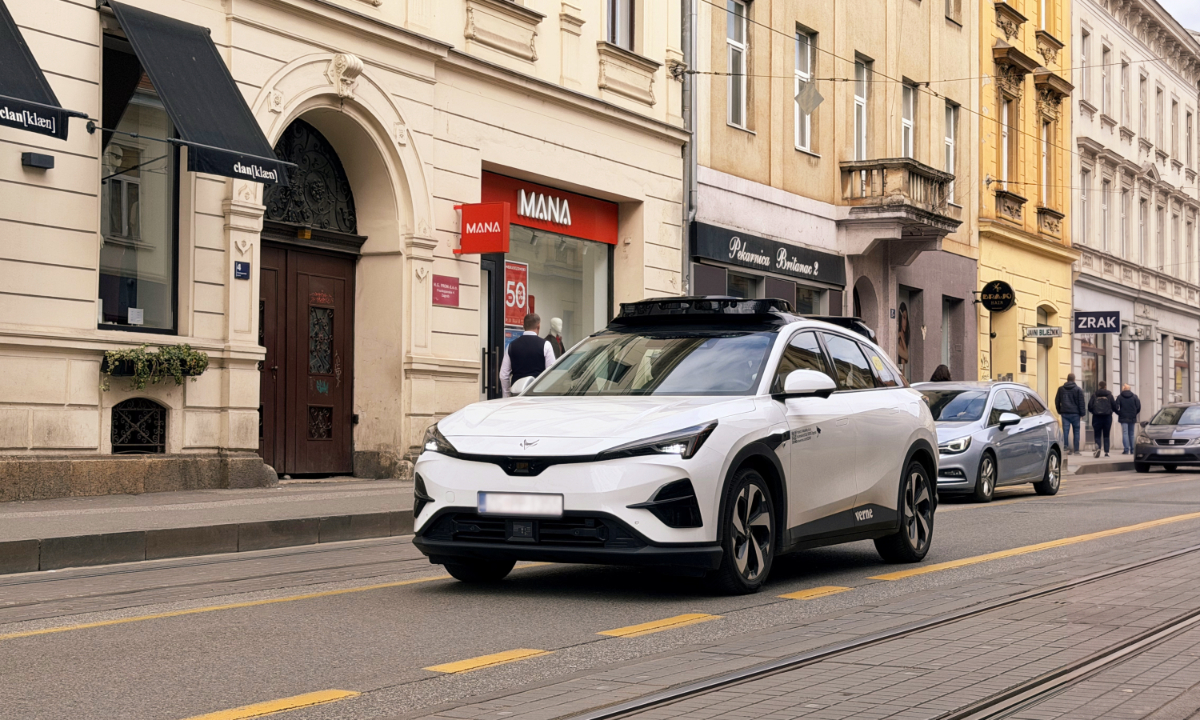
Chinese autonomous driving firm Pony.ai launched commercial robotaxi services in Zagreb, Croatia on April 8. Photo:Courtesy of Pony.ai
Chinese autonomous-driving company Pony.ai said on Monday that its cumulative autonomous-driving distance worldwide has surpassed 100 million kilometers, marking the latest milestone as China's driverless sector moves from technology validation toward mass production and scaled commercial deployment.
The milestone comes as L4 autonomous driving gains commercial traction across passenger transport and logistics in China, while Chinese companies are accelerating overseas deployment through partnerships with local operators in markets including Europe and Southeast Asia.
Industry experts said that the significance goes beyond rising distance. As commercialization gathers pace, the next phase of competition will increasingly hinge on whether autonomous-driving technology can be deployed at scale, brought down to commercially viable costs and replicated across different transport scenarios and markets.
At a recent media briefing, Pony.ai said that its fourth-generation L4 autonomous electric heavy-duty truck had entered mass production, with commercial operations expected to begin in the coming months. The company plans to deploy 500 to 1,000 trucks over the next two to three years across long-haul freight, bulk cargo transport and port logistics.
A notable part of that transition is the sharp decline in costs. Autonomous-driving hardware costs for Pony.ai's fourth-generation heavy truck are about 70 percent lower than for the previous generation, according to the company.
Similar cost reductions are also emerging in robotaxis. Pony.ai said on its official blog that the bill-of-materials cost of the autonomous-driving kit for its seventh-generation robotaxi has fallen 70 percent from the previous generation, helping the company achieve unit-economics breakeven in Guangzhou and Shenzhen, South China's Guangdong Province.
China's autonomous-driving sector is moving from technology validation to large-scale commercial deployment, underpinned by the rapid accumulation of real-world driving data, Pan Helin, a member of the Expert Committee for the Ministry of Industry and Information Technology, told the Global Times on Monday.
"Continuous road testing allows L4 systems to better adapt to local traffic conditions, laying the groundwork for wider commercial use," Pan said.
China has opened multiple cities to autonomous-driving applications, with commercialization gathering pace. As deployment expands and marginal technology costs fall, autonomous driving is expected to unlock significant commercial value and emerge as a new form of mobility, veteran industry analyst Liu Dingding told the Global Times.
Pony.ai aims to expand its robotaxi fleet to more than 3,000 vehicles by the end of 2026 and operate in 20 cities worldwide, with nearly half of those cities overseas. It also plans to develop an international version of its seventh-generation robotaxi tailored to different regulatory requirements and infrastructure, supporting the deployment of more than 1,000 vehicles in overseas markets.
Pony.ai's ambition also reflects a broader push by Chinese autonomous-driving companies to expand overseas.
On August 3, WeRide announced a partnership with Danish shared-mobility platform GreenMobility to deploy autonomous ride-hailing services in Denmark, marking its first entry into the Nordic region and sixth European market. Subject to regulatory approval, the service is expected to open to the public in the first half of 2027 using WeRide's latest GXR L4 robotaxi.
WeRide said on its website that its autonomous-driving products are now deployed in more than 40 cities across 12 countries. The company holds autonomous-driving permits in eight markets and operates a global L4 fleet of more than 3,000 vehicles.
A similar expansion is taking place in public transport. On July 17, Chinese autonomous-driving company MOGOX announced a strategic partnership with Singapore-based ComfortDelGro Bus. The two companies will cooperate on autonomous-vehicle deployment and operations, commercial expansion and coordination with regulators.
Pan said that China's autonomous-driving sector has two key advantages: a broad supplier base for major components and a large domestic market that allows companies to deploy services widely and accumulate real-world data. Advances in simulation and synthetic-data technologies have further strengthened the sector's ability to train and refine autonomous-driving systems.
Liu pointed to the cost benefits of scale. As deployment expands, the cost of key automotive-grade components such as lidar and chips continues to fall, improving the economics of commercial operations and creating more room for technological iteration, he said.
。
Current article:http://oi4h9zf.shuazhepenxingshuaisenqienai.buzz/xkp/gex.html
Published on:13:41:16
